

6 Miles In 1 Hour
Pace Figurer
Apply the post-obit computer to estimate the pace for a variety of activities, including running, walking, and biking. The calculator can besides be used to estimate the time taken or distance traveled with a given step and fourth dimension or distance.
Multipoint Stride Reckoner
The following calculator can determine the stride of segments of a run (or other action) for those with access to the time at intermittent points during the run. For case, if a person runs from point A to signal B, then to point C, records the fourth dimension at each point, and subsequently determines the distance betwixt those points (using many available websites, applications, or maps), the multipoint reckoner can make up one's mind how fast the person traveled betwixt each pair of points, allowing use for training purposes; a person can run the same route (or distance) repeatedly and track pace over that given route, enabling comparing of times between each segment (or lap) to identify areas for potential improvement.
| Distance | Time (hh:mm:ss) | ||
| ane. | |||
| 2. | |||
| 3. | |||
| 4. | |||
| five. | |||
| vi. | |||
| 7. | |||
| 8. | |||
| nine. | |||
| ten. | |||
| 11. | |||
| 12. | |||
| Your Preferred Pace Unit | |||
 | |||
Footstep Converter
| | = | ? | |
| | |||
Finish Fourth dimension Calculator
The following computer can be used to approximate a person's stop fourth dimension based on the time and distance covered in a race at the point the estimator is used.
| Current Distance Traveled | |
| Elapsed Fourth dimension | hh:mm:ss |
| Total Altitude | |
| | |
Typical Races and World Record Paces
| Category | Men's World Record Pace | Women's Earth Tape Footstep |
| 100 meters | 2:35/mile or 1:36/km | ii:49/mile or 1:45/km |
| 200 meters | ii:35/mile or 1:36/km | ii:52/mile or 1:47/km |
| 400 meters | 2:54/mile or 1:48/km | iii:12/mile or i:59/km |
| 800 meters | 3:23/mile or 2:06/km | three:48/mile or ii:21/km |
| one,500 meters | three:41/mile or 2:17/km | iv:07/mile or 2:34/km |
| 1 mile | 3:43/mile or 2:nineteen/km | iv:xiii/mile or 2:37/km |
| 5K | 4:04/mile or 2:31/km | 4:34/mile or two:50/km |
| 10K | 4:14/mile or two:38/km | 4:45/mile or 2:57/km |
| Half Marathon (xiii.eleven miles / 21.098 km) | 4:27/mile or 2:46/km | 4:58/mile or 3:05/km |
| Marathon (26.22 miles / 42.195 km) | 4:41/mile or two:55/km | five:10/mile or 3:xiii/km |
Training Through Pace and Heart Rate
Pace is a rate of activity or motion, while heart rate is measured as the number of times that a person's centre contracts over a minute. Pace and heart rate have a positive correlation; college step corresponds to higher eye charge per unit. The use of both in grooming can help a person better performance, avoid over-training, as well every bit rails progress and fitness over time.
Measuring and Estimating Heart Rate and Heart Rate Zones:
Heart rate can be measured in different ways, from using devices such as heart rate monitors, to simply looking at a watch while measuring pulse at some peripheral point such equally the wrist or neck. Some of the more than notable measurements of heart rate include resting heart rate and maximum middle charge per unit, which are often used to estimate specific target heart rate zones to make up one's mind unlike levels of exercise.
Typical adult resting heart rates (RHR) are commonly cited to range from 60-100 beats per infinitesimal (bpm), though there is some argument that normal RHRs really fall inside the range of 50-90 bpm. Mostly, a lower RHR indicates more efficient heart function, though RHRs that are lower than 50 bpm can exist a sign of an underlying middle condition or disease. The aforementioned is truthful of RHRs to a higher place 90 bpm.
Maximum middle rate (MHR) is most accurately measured using a cardiac stress test, which involves measuring a person's heart function (including heart charge per unit) at periodically increasing levels of exercise. These tests typically range from ten to twenty minutes in duration, which tin be inconvenient. As such, at that place are many estimates for MHR based on age, which is strongly correlated with heart rate, though there is piddling consensus regarding which formula should be used. The about commonly cited formula for calculating MHR is:
MHR = 220 – age
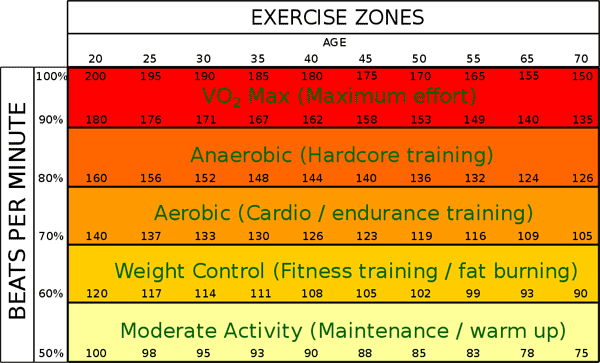
Although information technology is the most unremarkably cited formula, and is ofttimes used to make up one's mind center rate training zones, it does not have a reference to any standard deviation, and is not considered a adept predictor of MHR by reputable wellness and fettle professionals. Furthermore, MHRs vary significantly between individuals, fifty-fifty those with highly similar training and historic period within the same sport. Nevertheless, MHR determined using the in a higher place formula is often used to prescribe exercise grooming centre rate ranges, and can be beneficial equally a reference. Note that an exercise intensity level of 60-70% of maximum heart rate is considered the ideal range for burning fat. Refer to the figure below for further detail.
Exercise intensity levels and typical centre rates associated with said levels based on age
Aerobic vs. Anaerobic Exercise:
Aerobic and anaerobic practice are oftentimes mentioned in the context of endurance grooming and running. These types of exercise mainly differ based on the duration and the intensity of muscular contractions and the style in which energy is generated within the musculus. Generally, anaerobic exercises (~lxxx-90% MHR) involve brusque, intense bursts of activity while aerobic exercises (~70-eighty% MHR) involve light activity sustained over a long period of time. An exercise intensity level of 55-85% of MHR for 20-30 minutes is generally recommended to attain the best results from aerobic exercise.
In solely aerobic exercise, at that place is sufficient oxygen for a person's muscles to produce all the necessary energy for the exercise. In contrast, in anaerobic exercise, the cardiovascular organization cannot supply muscles with oxygen quickly plenty, and muscles suspension down sugar to supply the necessary free energy, resulting in excess of lactate (a byproduct of glucose metabolism). Backlog lactate causes the called-for awareness in muscles typical of anaerobic exercises and eventually makes the continuation of do not possible if excess lactate is not immune sufficient time to be removed from the bloodstream. Annotation that although lactate is too produced in aerobic weather, it is used virtually as speedily as information technology is formed at depression levels of exercise, and only trace amounts leak into the bloodstream from the muscles.
Agreement aerobic practice is particularly important when grooming for a long-distance activity such every bit a marathon. Determining a pace that tin be maintained while using energy primarily derived through aerobic ways, referred to as an "aerobic threshold pace," helps maintain a balance between fat and sugar utilization. This footstep requires a relatively low level of intensity, and is usually maintainable for a few hours. Increasing aerobic threshold pace allows for a faster sustainable pace and is a large attribute of many marathon training programs.
An anaerobic threshold footstep is defined by some as the threshold at which glycogen, rather than oxygen, becomes the primary source of free energy for the trunk. Notation that while anaerobic training will result in a person becoming more fit overall, it is not necessarily ideal training for a marathon, since an anaerobic footstep is not sustainable for long periods of time. This is not to say that a person should not perform any anaerobic training, every bit training at or slightly above their anaerobic threshold (the level of exercise intensity at which lactic acid builds up more than quickly than it can be removed from the bloodstream) can also be beneficial.
Similarly to eye rate, the most accurate way to determine these thresholds is through testing within a lab setting. Even so, both aerobic and anaerobic thresholds can too be estimated using a number of unlike methods, some of which involve the use of a heart charge per unit monitor. According to a 2005 written report, the virtually accurate way to determine anaerobic threshold (outside of blood work in a lab) is a 30-minute fourth dimension trial in which centre rate is monitored. In this time trial, a person must run at maximum effort, averaging their heart rate over the concluding xx minutes of the run. The boilerplate heart charge per unit over the last xx minutes is an estimation of the person's anaerobic threshold heart rate, also known as lactate threshold heart rate (LTHR). Information technology is important that the time trial be performed lonely. If it is done in a group setting, the duration must exist increased to lx minutes rather than xxx minutes. Aerobic threshold heart rate can be estimated past subtracting 30 beats per minute from the anaerobic threshold heart rate.
Substantially, threshold training involves preparation to postpone the bespeak at which lactate starts to build upwardly in the bloodstream, which effectively postpones the point of fatigue, potentially allowing a person to run farther and faster.

6 Miles In 1 Hour,
Source: https://www.calculator.net/pace-calculator.html
Posted by: mcguireyouck1956.blogspot.com
0 Response to "6 Miles In 1 Hour"
Post a Comment