

Advantages And Disadvantages Of Endoskeleton
37
Learning Goals
By the end of this reading you should exist able to:
- Differentiate between different types of skeletons and give examples of organisms with each type
- Describe the advantages and disadvantages of each type of skeleton
Introduction
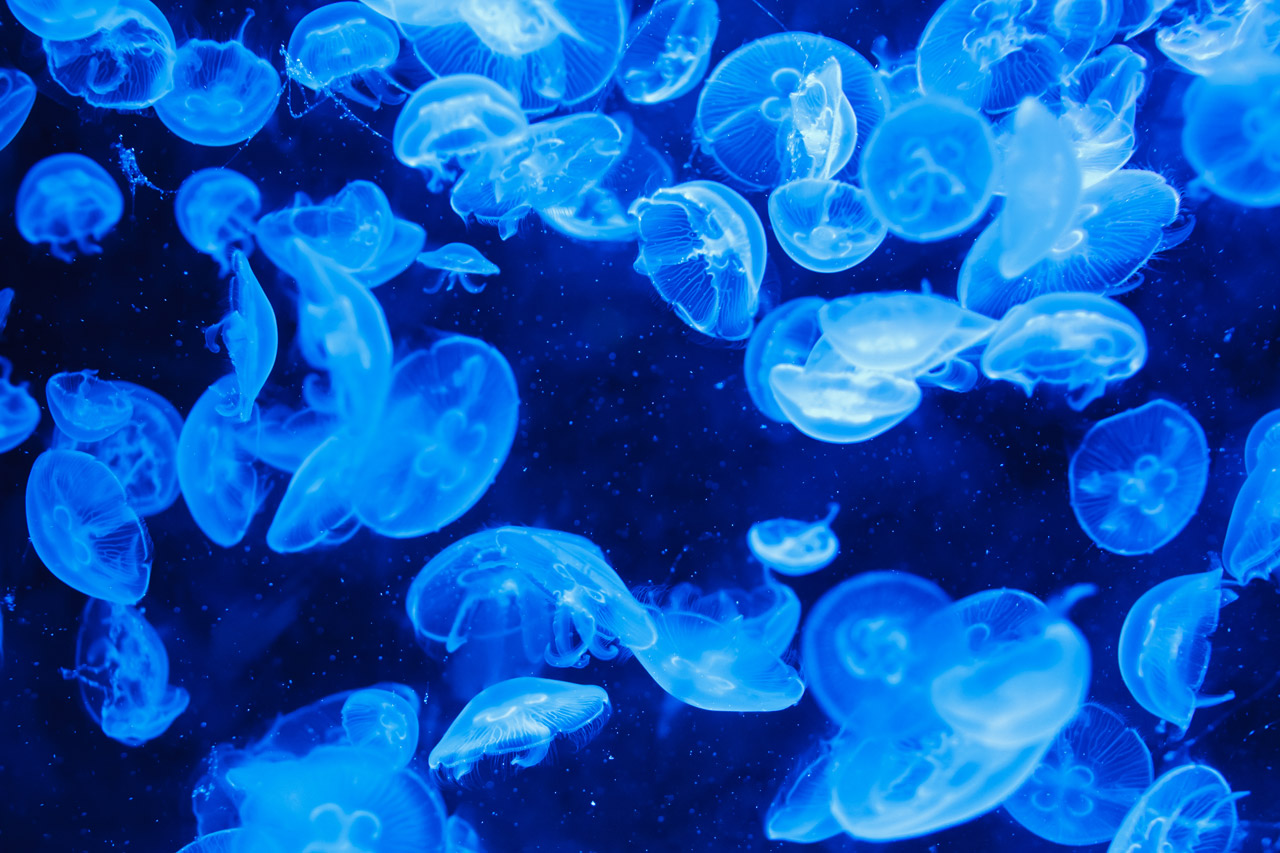
The earliest forms of life evolved in the oceans. The fact that this is an aquatic environment is key. Water is about 1,000 times denser than air. The loftier density of water allows organisms to float, due to a physical, upward force inherent in liquids known as buoyancy. Buoyancy allowed organisms to grow and achieve big sizes because the buoyancy strength supported the bodyweight of these animals. Even so, the density of water as well provides resistance to movement, and animals had to adapt to ensure that they were able to move efficiently through the h2o.
An early on adaptation by organisms was the power to alter the hydrostatic pressure within different chambers of their bodies to enable quick movement. This resulted in the development of hydrostatic skeletons . Animals with this type of skeleton include jellyfish, octopuses, and sea anemones. The changing shape of the animal reduces both friction and elevate.
Over time, in club to refine movement and improve protection from predators, some organisms developed a hard chitinous exoskeleton . Exoskeletons first developed in the aquatic surround in ancient arthropods. Animals with this type of skeleton include crustaceans like crabs and lobsters.
Eventually, at that place were some animals that developed a skeletal structure internal to the body, which would become the vertebrate grouping of animals. These animals take an endoskeleton . Initially, all endoskeletons were made of cartilage, which is a dense rubbery type of tissue. Later, endoskeletons of bone evolved.
Hydrostatic Skeletons
A hydrostatic skeleton is a construction found in many common cold-blooded and soft-bodied organisms. It consists of a fluid-filled cavity, which is surrounded by muscles. The cavity is called a coelom and in some animals, this cavity is filled with a blood-like substance calledhaemocoel. The fluid presses against the muscles, which in turn contract against the pressure of the fluid. The fluid is incompressible and thus maintains a abiding book against which the muscles can contract. The hydrostatic skeleton prevents the collapse of the torso. The muscles in the body act confronting the fluid and in doing and then bring about move. If the body is segmented, the pressure of the fluid is localised in a few segments at a time. Hydrostatic skeletons occur in flatworms, roundworms, earthworms, starfish and slugs.
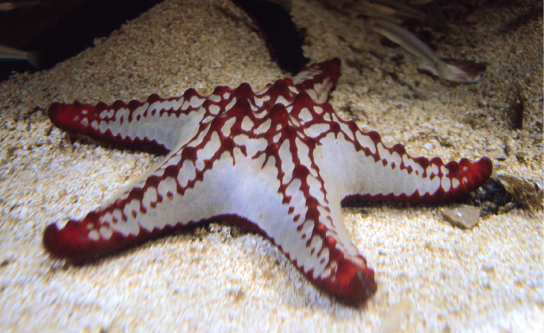
Movement in a hydrostatic skeleton is provided past muscles that environment the coelom. The muscles in a hydrostatic skeleton contract to change the shape of the coelom; the pressure of the fluid in the coelom produces move. For instance, earthworms motion past waves of muscular contractions of the skeletal musculus of the body wall hydrostatic skeleton, called peristalsis, which alternately shorten and lengthen the body. Lengthening the body extends the inductive end of the organism. Most organisms have a mechanism to prepare themselves in the substrate. Shortening the muscles and then draws the posterior portion of the trunk forward. Although a hydrostatic skeleton is well-suited to invertebrate organisms such as earthworms and some aquatic organisms, it is not an efficient skeleton for terrestrial animals.
Advantages of a hydrostatic skeleton
- Fluid shape: This allows organisms with hydrostatic skeletons to fit through oddly shaped passages, which is useful for burrowing or swimming.
- Strength: Creatures with hydrostatic skeletons can squeeze between spaces and aggrandize, making a 'prying open up' movement which allows them to force their way into various regions of rock and soil surfaces.
- Healing: Healing takes place faster in organisms with hydrostatic skeletons than in organisms with bone structures. This is because the haemocoel contained within the hydrostatic skeleton is made up generally of water, and thus, tin can be refilled apace. This allows many organisms with hydrostatic skeletons such equally earthworms to grow back their trunk mass after damage.
- Lightweight: The hydrostatic skeleton allows the fauna to motion in a more than flexible manner as it requires very little muscle mass for move.
- Circulation: The fluid cavity allows the circulation of nutrients and waste.
- Protection: The hydrostatic skeletons cushions the internal organs of the fauna from daze.
- Suited to the environment: Hydrostatic skeletons are suited for life in moist or aquatic environments, depending on the animal's adaptations.
Disadvantages of a hydrostatic skeleton
- Construction and surface for attachment: The hydrostatic skeleton lacks a structure and does not have surfaces for the zipper of muscles or limbs.
- Lack of protection: There is very lilliputian protection for the internal organs.
- Desiccation: A moist or water habitat is essential for the survival of these animals in guild to foreclose desiccation (drying out).
- Limited force: Terrestrial animals with hydrostatic skeletons cannot increase their body size as they would plummet nether their ain body weight.
Which of the following statements nigh hydrostatic skeletons is accurate?
A) The pressure of the fluid in the coelom produces movement
B) Hydrostatic skeletons are efficient skeletons for terrestrial animals.
C) Motility in a hydrostatic skeleton is provided by muscles that surround the coelom.
D) Lengthening the muscles draws the posterior portion of the body forward.
Exoskeletons
An exoskeleton is an external skeleton that supports and protects an animal's body. The skeleton is non-living and consists of a cuticle strengthened by chitin, a substance secreted by the epidermis (skin). Crustaceans such every bit crabs have their exoskeleton farther strengthened by calcium carbonate. There are muscles attached to the inside of the exoskeleton which provides the resistance needed for muscle action.
This skeleton-type provides defence against predators, supports the body, and allows for movement through the contraction of attached muscles. As with vertebrates, muscles must cross a joint inside the exoskeleton. Shortening of the muscle changes the relationship of the two segments of the exoskeleton. Arthropods such as crabs and lobsters have exoskeletons that consist of xxx–l per cent chitin, a polysaccharide derivative of glucose that is a strong but flexible cloth. Chitin is secreted past the epidermal cells. The exoskeleton is further strengthened by the addition of calcium carbonate in organisms such every bit the lobster. Considering the exoskeleton is acellular, arthropods must periodically shed their exoskeletons because the exoskeleton does not abound as the organism grows.
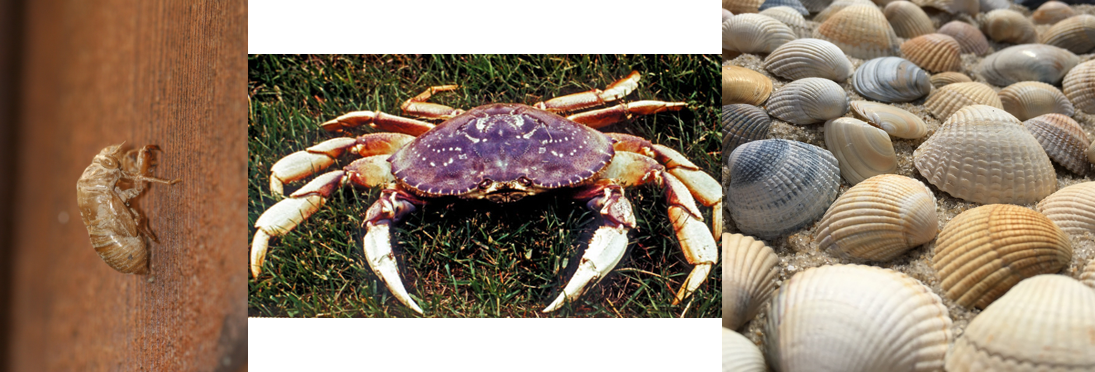
The exoskeleton is bars to animals such as insects, spiders, scorpions, venereal etc., all of which belong to the Phylum Arthropoda (jointed-legged and jointed-bodied animals). The exoskeleton acts every bit a hard outer covering and is made upwardly of a series of plates or tubes. We often call big exoskeletons `shells'.
Advantages of the exoskeleton
- Musculus attachment: The exoskeleton forms the bespeak of attachment of internal muscles needed for locomotion thereby providing better leverage for muscle action.
- Protection: The exoskeleton protects the soft internal tissues and organs.
- Back up: The exoskeleton provides structural back up and shape.
- Prevents Desiccation: The exoskeleton prevents desiccation (drying out) on land.
- Light-weight: The exoskeleton of insects has a depression density and is therefore lightweight, to permit for flight.
- Diversity: The mouth-parts tin can be modified for biting, sucking, piercing grasping thus providing for a diversified diet for organisms possessing an exoskeleton compared to those that practise not.
Disadvantages of the exoskeleton
- Size restriction: The last body size is express because every bit the body size increases, the surface surface area to volume ratio decreases. The larger the creature, the heavier the exoskeleton, making movement more difficult.
- The non-living skeleton does not grow with animals: The overall growth of the brute is restricted due to periodic moulting. Since the exoskeleton restricts growth, moulting is required to adapt for increases in the size of the animal.
- Vulnerability during moulting: The creature is vulnerable when information technology is in the moulting process because the new skeleton is very soft until the new exoskeleton has dried and hardened.
- Sites of structural weakness: Exoskeletons are weaker at the joints.
What is the key limitation to exoskeletons?
A) they are composed of living tissues
B) they cannot grow with the organisms
C) they tin can be molted (shed) equally the organism grows
Endoskeletons
An endoskeleton is a skeleton that consists of hard, mineralized structures located inside the soft tissue of organisms. The bones of vertebrates are composed of tissues and tin consist of os (all vertebrates except sharks) or cartilage (sharks) and some endoskeletons consist of both. Endoskeletons provide support for the body, protect internal organs, and allow for motion through the contraction of muscles attached to the skeleton.

Advantages of the endoskeleton
- Living: Endoskeletons consist of living tissue, so it is able to abound steadily within the animal enabling some to accomplish a big size.
- Structure and back up: The endoskeleton provides shape and structural support.
- Structural multifariousness and accommodation: The bones can vary in size and shape to support the brute'south mass.
- Flexible: The endoskeleton is jointed which allows for flexible movement and back up.
- Muscle attachment: The muscles attach directly to the skeletal bones to let for movement and support.
- Protection: The endoskeleton protects the vital organs such as the heart and lungs which are protected past the ribcage.
- Diversified locomotion: The development of an endoskeleton has allowed animals to get successfully adapted to locomotion in the environment in which they live. Vertebrates (organisms with a vertebral cavalcade and an endoskeleton) take become adapted to move in a number of dissimilar modes of locomotion, e.one thousand. running, jumping, pond, and flying.
Disadvantages of the endoskeleton
- Vulnerable to the external environment: The endoskeleton does not offer the fauna any protection from the exterior, be it a physical attack or changes in environmental conditions. The beast is therefore very vulnerable.
- Susceptible to illness: The skeleton consists of living tissue so is susceptible to infections and disease.
Which of these is/are an advantage of endoskeletons?
A) they provide protection from the surroundings for organisms
B) they provide attachment sites for muscles
C) bone shapes and size vary providing a variety of motility
D) can provide protection for internal organs
Summary
The three types of skeleton designs are hydrostatic skeletons, exoskeletons, and endoskeletons. A hydrostatic skeleton is formed by a fluid-filled compartment held under hydrostatic pressure level; motion is created past the muscles producing pressure on the fluid. An exoskeleton is a difficult external skeleton that protects the outer surface of an organism and enables movement through muscles attached to the within. An endoskeleton is an internal skeleton composed of hard, mineralized tissue that also enables movement by attachment to muscles.
REVIEW: Endo vs. Exoskeletons
1) How practise endoskeletons vary from exoskeletons?
A) an endoskeleton lies internal to most of the body'southward soft tissues: exoskeletons prevarication outside these tissues
B) endoskeletons abound with an organism: exoskeletons must be shed and regrown
C) Exoskeletons can be repaired hands following impairment: endoskeletons are more difficult to repair
D) Exoskeletons can provide protection for internal organs: endoskeletons cannot
REVIEW: Exoskeletons
2) The principal component of the insect exoskeleton is _________ . Interestingly this molecule is also found in the ________ of what grouping of organisms? __________
3) Equally animals evolved to live on country they didn't all arrange their skeletons in the same fashion. In a terrestrial environment what are the advantages of an exoskeleton? What most an endoskeleton?
References

Advantages And Disadvantages Of Endoskeleton,
Source: https://viva.pressbooks.pub/introbio2/chapter/11-1-types-of-skeletons/
Posted by: mcguireyouck1956.blogspot.com
0 Response to "Advantages And Disadvantages Of Endoskeleton"
Post a Comment